
ACQUISITION FRAMEWORK & PRICING RATIONALE
Blackstone Group OPS operates under a transparent, value-based pricing model designed for seamless federal and state acquisition. Our procurement pathway is optimized for Force Preservation — shifting the economic focus from 'unit cost' to the mitigation of the $3.7B annual MSKI burden.
GSA Schedule: MAS-SIN 311423 | NCAGE Code: 107BW | Status: NATO Aligned & Vetted
ONS-01: A single-serve, field-deployable physiological support system designed for sustained integration within military operational cycles.
1. SYSTEM VALUE PILLARS & COST-BENEFIT RATIO
The ONS-01 pricing architecture reflects its status as medical-grade operational infrastructure. Unlike commercial alternatives, ONS-01 is engineered to meet the extreme demands of the Joint Force supply chain.
1: Medical-Grade Purity
ONS-01 is a zero-filler, medical-grade matrix designed for 100% bioavailability. It ensures the daily intake of 90g of high-density protein (via the 3-sachet protocol) is absorbed effectively by the human weapon system, even under extreme physiological stress where standard digestion often fails.
2: Logistical Cost-Reduction
- By eliminating the requirement for cold-chain logistics, refrigeration, and specialized handling, ONS-01 reduces the total operational cost of high-protein delivery. It is 100% shelf-stable from -40°F to 122°F (-40°C to +50°C), ensuring mission-readiness in any theater.
3: Fiscal Risk Mitigation
- Procurement of ONS-01 is a direct investment in reducing the $3.7B annual MSKI liability. By preventing structural degradation before it leads to limited-duty status, ONS-01 pays for itself through preserved operational capacity and reduced medical evacuation costs.
2. INDUSTRIAL SCALE & FORCE-WIDE REQUIREMENTS
Procurement logic for ONS-01 is based on Mass-Scale Readiness. While 260 metric tons of medical-grade protein appears substantial, the logistical reality of the U.S. Army and NATO forces requires industrial-scale thinking.
The Math of Readiness:
- 1 Metric Ton (MOQ) fulfills the required 3-sachet daily protocol for only 312 personnel for 30 days. This represents the baseline entry point for unit-level integration.
The Force Gap:
- Our current 260-ton monthly capacity serves approximately 81,000 personnel — less than 1.5% of approx. 6-million-strong U.S./NATO aligned force. ONS-01 is prioritized for high-readiness units and strategic reserves.
Logistical Lead Times:
- Standard fulfillment (1-10 Tons) carries a 40-day lead time. Industrial-scale fulfillment (10+ Tons) requires coordinated logistics scheduling from factory to port. Master Purchase Agreements (MPAs) are recommended for guaranteed delivery windows.
3. The Economics of Readiness: FISCAL IMPACT & ROI ANALYSIS
The Military’s Most Expensive Problem: Musculoskeletal Injuries (MSKI)
While the daily cost of ONS-01 is fixed at GSA rates, the Cost of Inaction is volatile and extreme. Musculoskeletal Injuries (MSKI) are the primary driver of medical evacuation, non-deployability, and early discharge across the Joint Force. ONS-01 serves as a fiscal hedge against these systemic readiness failures.
- The Annual Burden: MSKIs cost the U.S. Department of Defense over $3.7 Billion annually in direct medical expenditures and lost operational throughput.
- The Individual Event: A single combat or training-related injury (tears, fractures, or chronic degradation) is estimated to cost the DoD tens of thousands of dollars per incident—extending beyond surgery to include the cost of evacuation and the replacement of specialized personnel.
- The Readiness Gap: "Limited Duty" status represents a hidden deficit of over $4 Billion to the Army alone. Personnel remain on the payroll but are functionally mission-incapable, creating a critical gap in force strength.
4. Phased Industrial Expansion & Sovereign Supply
Blackstone Group OPS is executing a strategic industrial roadmap to move from NATO-aligned fulfillment to a 100% domestic, sovereign U.S. supply chain. Our pricing architecture supports the establishment of high-volume manufacturing infrastructure to meet the surge requirements of the Joint Force.
CURRENT CAPABILITY (PHASE I)
NATO-Aligned Fulfillment
- Currently, ONS-01 is fulfilled through our high-capacity facility in France. With a validated output of 260 metric tons per month, we ensure immediate mission-readiness for U.S. and NATO-aligned forces globally. This facility maintains the highest medical-grade purity standards and rigorous quality control for theater-wide deployment.
THE TEXAS ROADMAP (PHASE II)
$500M Sovereign Industrial Hub
- We are transitioning to a permanent, 100% U.S.-based manufacturing hub in Texas. This expansion is designed to provide the U.S. Army and Strategic Reserve with Domestic Surge Capacity. By securing Master Purchase Agreements today, procurement officers are directly supporting the creation of a veteran-led workforce of 20,000 and the security of the American defense industrial base.
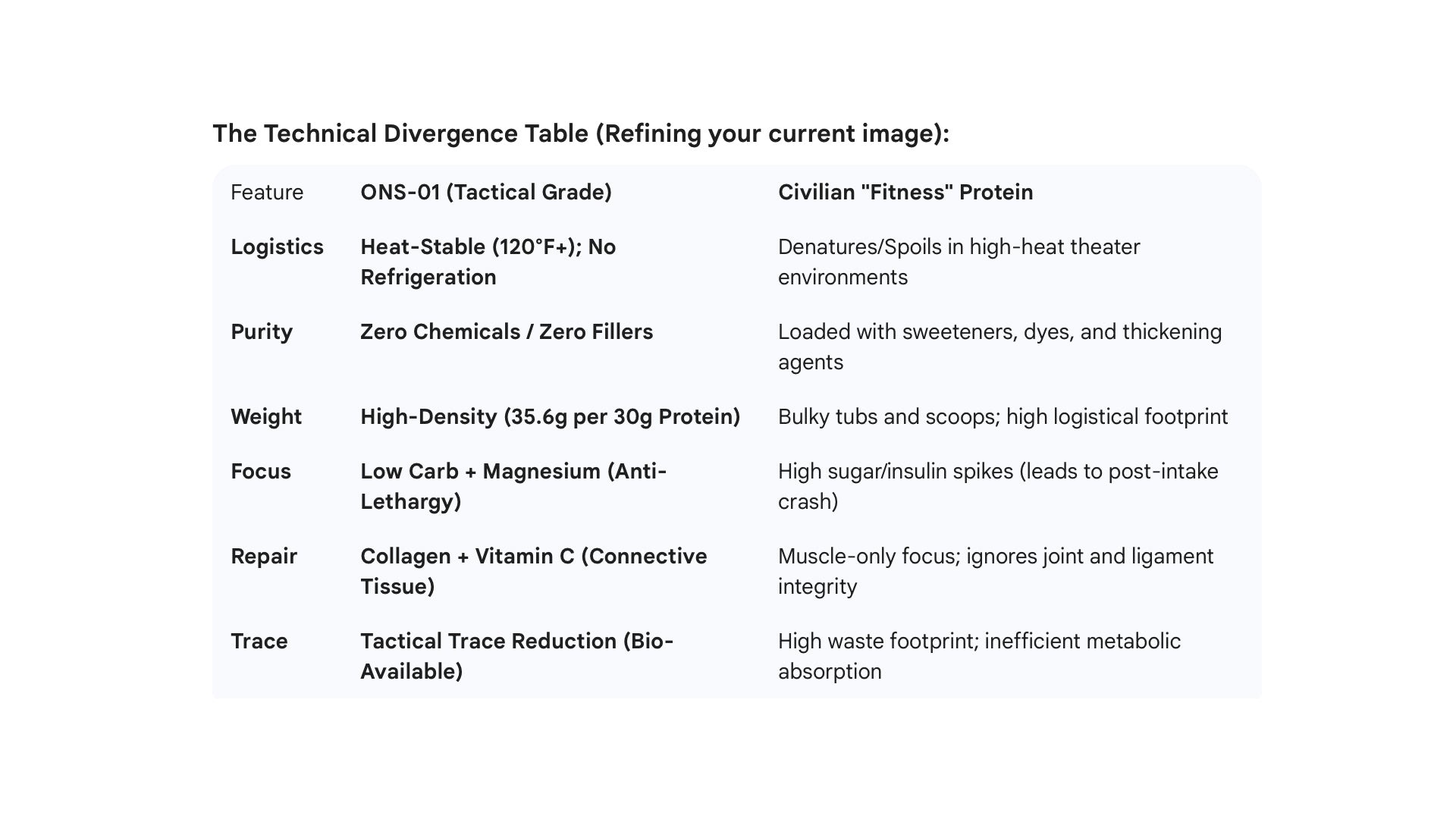
5. The "No Comparison" Metric: ONS-01 vs. Civilian Protein
Standard civilian protein is engineered for the fitness market; ONS-01 is engineered for the Operational Environment. Military procurement requires a standard of stability, purity, and physiological impact that civilian 'fitness' products cannot meet. Below is the technical divergence between retail supplements and tactical-grade sustainment.
6. Mitigating Foreign Supply Chain Dependency
Blackstone Group OPS is committed to the long-term fortification of the U.S. Defense Industrial Base. By onshoring 100% of ONS-01 production to the United States, we eliminate strategic risks associated with foreign-sourced physiological sustainment and ensure the total integrity of the American supply chain.
The Structured Expansion Model
- Scalable Domestic Infrastructure: Activation of multi-site U.S. production facilities to meet national and allied force-level requirements.
- Contract-Synchronized Growth: Infrastructure activation is directly proportional to awarded contract volume, ensuring logistical stability and delivery certainty.
- Self-Funded Industrial Resilience: Capital deployment is aligned with federal procurement stability, ensuring a robust and self-sustaining supply chain.
The "Strategic Assurance" Block
Expansion is structured to scale alongside multi-year defense requirements—prioritizing supply chain continuity over speculative overbuild.
This ensures:
- Controlled Capital Deployment: Fiscal responsibility in infrastructure scaling.
- Supply Chain Continuity: Guaranteed availability through transition phases. Ensures sustained integration of ONS-01 throughout the entirety of multi-year operational and training cycles.
- Zero Speculative Overbuild: A lean, high-efficiency production model tailored to actual force demand.
7. Strategic Human Capital: Veteran-Led Industrial Excellence
Future U.S.-based Blackstone Group OPS facilities are engineered to serve as centers of excellence for veteran employment. By prioritizing the recruitment of U.S. military veterans across all operational and technical tiers, we ensure that our production environments are governed by a workforce that inherently understands the mission-critical nature of ONS-01.
The Strategic Initiative
- Operational Cultural Alignment: We integrate personnel with direct mission experience to maintain a high-discipline, zero-fail production standard.
- Mission-Specific Synergy: Veteran leadership ensures that industrial output remains synchronized with evolving defense objectives and warfighter needs.
- Long-Term Sector Stability: Our commitment supports national industrial base workforce initiatives by providing high-skill, permanent career paths for transitioning service members.
Economic Impact Data
Each Primary U.S. Facility is projected to generate:
- 1,500 – 2,000 High-Skill American Jobs
- Direct Alignment with Federal Industrial Workforce Initiatives
Veteran workforce integration eliminates onboarding friction and guarantees a mission-first culture within the production lifecycle.
8. Supply Chain Continuity & Redundancy
Blackstone Group OPS ensures uninterrupted force support through a dual-continent manufacturing strategy. This redundancy eliminates 'single-point-of-failure' risks and provides the Department of Defense with a secure bridge during our transition to 100% domestic sovereign production.
The "Operational Redundancy" Breakdown:
- The NATO-U.S. Bridge: Until the 100% activation of our Texas Industrial Hub, all U.S. requirements are fulfilled via our validated French facility. This ensures that current 'Force Preservation' programs remain active without dependency on future construction timelines.
- Logistical Mitigation: To offset the 40-day trans-Atlantic shipping window, Blackstone Group OPS maintains 'Strategic Buffer Stocks' for Master Purchase Agreement (MPA) holders. This ensures that even during geopolitical or maritime disruptions, your units have immediate access to ONS-01.
- Diversified Sourcing: All raw materials are sourced from multi-line, pre-vetted providers across NATO-aligned nations. This diversification guarantees that our 260 metric-ton monthly output is protected against regional supply shocks.
9. Strategic Depth: Multi-Theater Reserve Alignment
Unlike standard perishable rations, the ONS-01 industrial model is optimized for long-term Strategic Reserve placement. Our manufacturing structure allows for the rapid transition from standard training fulfillment to high-intensity surge requirements without compromising supply chain integrity.
The "Operational Depth" Advantage:
- Long-Term Shelf Stability: ONS-01 is engineered for extended storage in varied climate conditions, making it an ideal asset for Pre-Positioned Stocks (PREPO) and Strategic Reserves.
- Rapid Surge Escalation: Our production lines are designed with 'Modular Scalability.' In theater-opening or surge scenarios, we can pivot production volumes to support rapid force mobilization across NATO-aligned theaters.
- Replenishment Readiness: We offer structured 'Rolling Reserve' programs, ensuring that your strategic stockpiles are systematically rotated and refreshed, maintaining 100% force-readiness at all times.
The "Strategic Note"
Capacity signaling is based on active operational infrastructure, ensuring that surge requirements are met with physical assets, not theoretical projections.
10. ONS-01SF: Aerospace & Extreme-Environment Adaption
ONS-01SF is a specialized, gel-based delivery system engineered for environments where standard hydration and mixing protocols are operationally impractical. This adaptation is designed to mitigate the accelerated musculoskeletal degradation inherent in aerospace and microgravity deployment.
Design Specifications
- Microgravity Stability: Engineered for zero-leak, high-viscosity consumption in orbital or sub-orbital environments.
- Aerospace Performance Integration: Provides rapid physiological fortification for pilots and crew facing high-G stressors and prolonged mission durations.
- Extended-Duration Sustainment: Optimized for the unique metabolic demands of long-range aerospace operations where traditional logistics are restricted.
The Capability Statement
ONS-01SF addresses the specific 'bone-and-joint density' loss observed in prolonged microgravity, providing a standalone sustainment solution that remains independent of ground-force logistical structures.
A single-serve, field-deployable physiological support system designed for sustained integration within military operational cycles.
— U.S. Embassy London, ODC
11. Contractual Data & Strategic Engagement
The Formal Procurement Block
- GSA Schedule: MAS (SIN 311423)
- Contractor: Blackstone Group LLC-FZ
- NCAGE Code: 107BW
- Status: NATO Aligned & Vetted
Strategic Liaison
- Executive Lead: Mario M. Radosavljevic, Executive Director
- Direct Coordination: mario-radosavljevic@blackstonegroupdubai.com
The Final "Big Scale" Note
Letters of Intent (LOI) regarding the $500M Texas Industrial Hub construction and Division-level Master Purchase Agreements (MPA) are available for review by authorized DoD, State, and Congressional officials upon request.